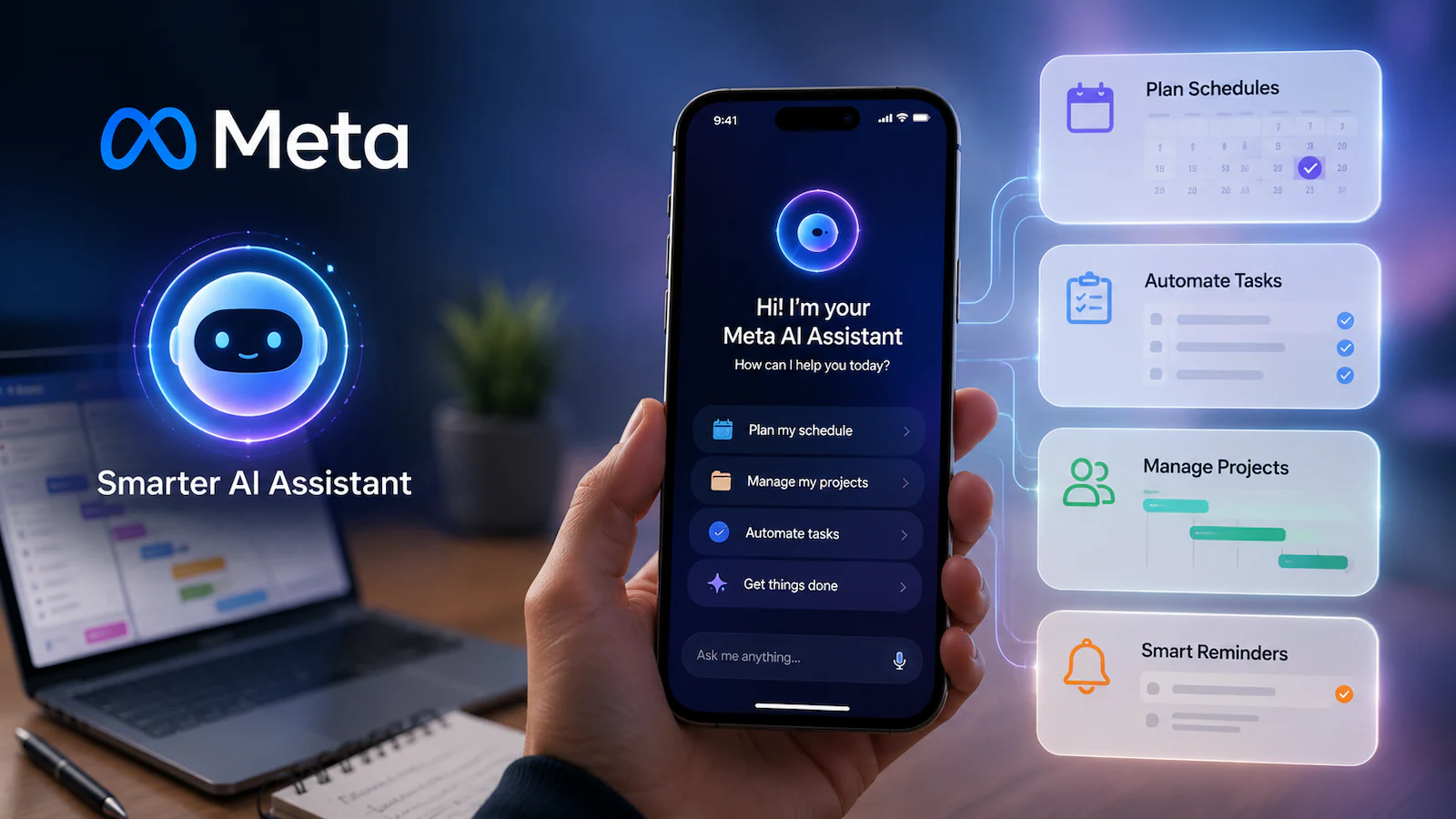
Artificial Intelligence continues to reshape the way people work, communicate, and manage their daily lives. As the AI race intensifies among technology giants, Meta has announced a significant upgrade to its AI Assistant by introducing advanced task automation features and strengthening its vision for personal AI. The update has quickly gained attention across social media platforms, with users, tech enthusiasts, and industry experts discussing its potential to transform digital experiences.
The announcement reflects Meta's broader strategy of integrating AI into everyday applications, making virtual assistants more capable of handling routine tasks, providing personalized recommendations, and improving productivity. With millions of users already interacting with Meta AI through Facebook, Instagram, WhatsApp, and Messenger, these new features represent a major step toward creating a truly intelligent digital assistant.
In this blog, we'll explore what Meta's latest AI upgrade includes, why it has become a trending topic on social media, how it compares with competing AI assistants, and what it means for the future of personal AI.
What Is Meta AI?
Meta AI is the company's artificial intelligence assistant designed to help users perform everyday tasks through natural language conversations. Built using Meta's advanced large language models, the assistant is integrated into several Meta platforms, allowing users to ask questions, generate content, receive recommendations, and complete various digital activities without leaving the app.
Unlike traditional chatbots, Meta AI aims to become a personalized digital companion capable of understanding user preferences, habits, and context to provide more meaningful assistance.
What's New in the Latest Update?
The latest upgrade introduces task automation capabilities, allowing Meta AI to perform actions on behalf of users rather than simply responding to prompts.
Some of the newly introduced capabilities include:
Scheduling reminders
Managing recurring tasks
Personalized recommendations
Context-aware assistance
Cross-platform AI experiences
Improved conversational memory
Smarter planning assistance
Enhanced productivity features
Instead of acting as a simple chatbot, Meta AI is gradually evolving into an intelligent assistant capable of helping users organize their daily routines.
Understanding Task Automation
Task automation enables AI to perform repetitive or scheduled actions with minimal user intervention.
Examples include:
Reminding users about appointments
Sending notifications at specific times
Organizing shopping lists
Managing daily schedules
Tracking ongoing tasks
Recommending actions based on previous interactions
This shift moves AI beyond answering questions and toward actively assisting users throughout the day.
Meta's Vision for Personal AI
Meta describes its long-term goal as creating a personal AI that understands individual preferences and becomes increasingly helpful over time.
Rather than providing generic responses, personal AI focuses on:
Understanding user habits
Learning communication preferences
Remembering important information
Providing contextual recommendations
Offering proactive assistance
As AI becomes more personalized, users spend less time repeating information and more time completing tasks efficiently.
Why Is This Trending on Social Media?
The announcement quickly became a trending topic because it combines two of today's biggest technology conversations:
Artificial Intelligence
Productivity Automation
Users across social media platforms have been actively discussing the update for several reasons.
1. Growing AI Competition
Meta joins major technology companies investing heavily in AI assistants.
Consumers are naturally comparing Meta AI with alternatives offered by other leading AI platforms.
This competition creates excitement because every new feature raises expectations for smarter digital assistants.
2. Everyday Practical Use
Unlike experimental AI announcements, Meta's update focuses on features users can actually benefit from daily.
People appreciate AI that helps with:
Planning schedules
Managing reminders
Organizing daily activities
Increasing productivity
Practical AI receives more attention than purely technical improvements.
3. Integration Across Popular Apps
Meta owns several of the world's most widely used platforms:
Facebook
Instagram
WhatsApp
Messenger
Integrating AI across these services means millions of users could experience the new features without downloading additional software.
This broad accessibility significantly increases online discussions.
4. Personal AI Is Becoming Reality
For years, technology companies have discussed the concept of digital personal assistants.
Meta's latest announcement suggests this vision is moving closer to reality.
The idea of AI remembering preferences, assisting with tasks, and improving over time naturally generates curiosity among users.
5. Productivity Benefits
Students, professionals, entrepreneurs, and creators constantly look for ways to save time.
Automation features promise:
Better organization
Faster task completion
Reduced mental workload
Improved productivity
These benefits make the update highly relevant to everyday users.
How Meta AI Compares With Other AI Assistants
Today's AI market is highly competitive.
While many AI assistants provide conversational responses, Meta is focusing on deeper integration within its social ecosystem.
Key differentiators include:
Native integration across Meta apps
Social communication support
Personalized assistance
Context-aware interactions
Everyday productivity features
As competition increases, users are likely to benefit from faster innovation across the AI industry.
Potential Benefits for Users
The upgraded Meta AI offers several advantages.
Better Time Management
Users can organize tasks more efficiently through automated reminders and scheduling.
Simplified Daily Planning
Routine activities become easier to manage through AI-powered assistance.
Personalized Recommendations
AI learns user preferences to provide increasingly relevant suggestions.
Increased Productivity
Automation reduces repetitive manual work and allows users to focus on higher-value activities.
Improved User Experience
Natural conversations combined with personalized assistance create a smoother digital experience.
Potential Challenges
While the announcement has generated excitement, users have also raised several important questions.
Privacy
Many users wonder how personal information will be stored and used to improve AI experiences.
Maintaining transparency will be essential.
Data Security
As AI remembers more user preferences, protecting personal information becomes increasingly important.
Strong security measures will play a critical role.
User Trust
For personal AI to succeed, users must trust the assistant with sensitive information and daily planning.
Building that trust requires reliable performance and responsible data handling.
What This Means for Businesses
Businesses may also benefit from more capable AI assistants.
Potential advantages include:
Faster customer interactions
Improved marketing automation
Better customer engagement
Enhanced communication
Increased workplace productivity
Brands using Meta platforms may eventually integrate AI-powered automation into customer experiences.
The Future of Personal AI
Meta's announcement highlights a broader industry trend.
Future AI assistants are expected to become:
More proactive
More personalized
Better integrated
Context-aware
Capable of completing complex workflows
Instead of simply answering questions, AI will increasingly help users manage daily life.
This represents one of the most significant shifts in consumer technology over the coming years.
Why Social Media Continues Discussing It
Several factors continue driving conversations online.
People are debating:
How useful the automation features will be
Whether Meta AI can compete with other AI assistants
Privacy implications
Productivity improvements
Future AI capabilities
Technology announcements that combine innovation with everyday usability typically receive widespread engagement across social platforms.
Final Thoughts
Meta's latest upgrade to its AI Assistant marks another important milestone in the evolution of artificial intelligence. By introducing task automation features and advancing its vision of personal AI, the company is moving beyond traditional chatbot interactions toward creating a more intelligent, proactive, and personalized digital assistant.
The announcement has gained significant traction on social media because it addresses real-world productivity needs while highlighting the growing competition among AI providers. Users are excited about the potential for smarter automation, seamless integration across Meta's platforms, and AI that can better understand their daily routines.
As artificial intelligence continues to evolve, personal AI is expected to become an essential part of how people communicate, organize tasks, and interact with technology. Meta's latest update demonstrates that the future of AI is not just about answering questions - it's about becoming a trusted digital assistant that simplifies everyday life.
Frequently Asked Questions (FAQs)
1. What is Meta's latest AI Assistant upgrade?
Meta has introduced new task automation features and enhanced personalization capabilities, allowing its AI Assistant to help users manage reminders, schedules, and everyday tasks more effectively.
2. Why is Meta AI trending on social media?
The announcement is trending because it showcases practical AI automation, deeper integration across Meta's platforms, and the company's broader push toward creating a personalized AI assistant.
3. What are task automation features?
Task automation features enable AI to perform routine actions such as scheduling reminders, organizing tasks, and providing proactive assistance instead of only responding to user queries.
4. How does Meta's personal AI differ from traditional chatbots?
Personal AI is designed to remember user preferences, understand context, and provide personalized, proactive assistance rather than offering one-time responses.
5. What could this mean for the future of AI?
The update signals a shift toward AI assistants that are more integrated, personalized, and capable of managing everyday activities, potentially changing how users interact with technology across work and personal life.
Artificial Intelligence continues to reshape the way people work, communicate, and manage their daily lives. As the AI race intensifies among technology giants, Meta has announced a significant upgrade to its AI Assistant by introducing advanced task automation features and strengthening its vision for personal AI. The update has quickly gained attention across social media platforms, with users, tech enthusiasts, and industry experts discussing its potential to transform digital experiences.
The announcement reflects Meta's broader strategy of integrating AI into everyday applications, making virtual assistants more capable of handling routine tasks, providing personalized recommendations, and improving productivity. With millions of users already interacting with Meta AI through Facebook, Instagram, WhatsApp, and Messenger, these new features represent a major step toward creating a truly intelligent digital assistant.
In this blog, we'll explore what Meta's latest AI upgrade includes, why it has become a trending topic on social media, how it compares with competing AI assistants, and what it means for the future of personal AI.
What Is Meta AI?
Meta AI is the company's artificial intelligence assistant designed to help users perform everyday tasks through natural language conversations. Built using Meta's advanced large language models, the assistant is integrated into several Meta platforms, allowing users to ask questions, generate content, receive recommendations, and complete various digital activities without leaving the app.
Unlike traditional chatbots, Meta AI aims to become a personalized digital companion capable of understanding user preferences, habits, and context to provide more meaningful assistance.
What's New in the Latest Update?
The latest upgrade introduces task automation capabilities, allowing Meta AI to perform actions on behalf of users rather than simply responding to prompts.
Some of the newly introduced capabilities include:
Scheduling reminders
Managing recurring tasks
Personalized recommendations
Context-aware assistance
Cross-platform AI experiences
Improved conversational memory
Smarter planning assistance
Enhanced productivity features
Instead of acting as a simple chatbot, Meta AI is gradually evolving into an intelligent assistant capable of helping users organize their daily routines.
Understanding Task Automation
Task automation enables AI to perform repetitive or scheduled actions with minimal user intervention.
Examples include:
Reminding users about appointments
Sending notifications at specific times
Organizing shopping lists
Managing daily schedules
Tracking ongoing tasks
Recommending actions based on previous interactions
This shift moves AI beyond answering questions and toward actively assisting users throughout the day.
Meta's Vision for Personal AI
Meta describes its long-term goal as creating a personal AI that understands individual preferences and becomes increasingly helpful over time.
Rather than providing generic responses, personal AI focuses on:
Understanding user habits
Learning communication preferences
Remembering important information
Providing contextual recommendations
Offering proactive assistance
As AI becomes more personalized, users spend less time repeating information and more time completing tasks efficiently.
Why Is This Trending on Social Media?
The announcement quickly became a trending topic because it combines two of today's biggest technology conversations:
Artificial Intelligence
Productivity Automation
Users across social media platforms have been actively discussing the update for several reasons.
1. Growing AI Competition
Meta joins major technology companies investing heavily in AI assistants.
Consumers are naturally comparing Meta AI with alternatives offered by other leading AI platforms.
This competition creates excitement because every new feature raises expectations for smarter digital assistants.
2. Everyday Practical Use
Unlike experimental AI announcements, Meta's update focuses on features users can actually benefit from daily.
People appreciate AI that helps with:
Planning schedules
Managing reminders
Organizing daily activities
Increasing productivity
Practical AI receives more attention than purely technical improvements.
3. Integration Across Popular Apps
Meta owns several of the world's most widely used platforms:
Facebook
Instagram
WhatsApp
Messenger
Integrating AI across these services means millions of users could experience the new features without downloading additional software.
This broad accessibility significantly increases online discussions.
4. Personal AI Is Becoming Reality
For years, technology companies have discussed the concept of digital personal assistants.
Meta's latest announcement suggests this vision is moving closer to reality.
The idea of AI remembering preferences, assisting with tasks, and improving over time naturally generates curiosity among users.
5. Productivity Benefits
Students, professionals, entrepreneurs, and creators constantly look for ways to save time.
Automation features promise:
Better organization
Faster task completion
Reduced mental workload
Improved productivity
These benefits make the update highly relevant to everyday users.
How Meta AI Compares With Other AI Assistants
Today's AI market is highly competitive.
While many AI assistants provide conversational responses, Meta is focusing on deeper integration within its social ecosystem.
Key differentiators include:
Native integration across Meta apps
Social communication support
Personalized assistance
Context-aware interactions
Everyday productivity features
As competition increases, users are likely to benefit from faster innovation across the AI industry.
Potential Benefits for Users
The upgraded Meta AI offers several advantages.
Better Time Management
Users can organize tasks more efficiently through automated reminders and scheduling.
Simplified Daily Planning
Routine activities become easier to manage through AI-powered assistance.
Personalized Recommendations
AI learns user preferences to provide increasingly relevant suggestions.
Increased Productivity
Automation reduces repetitive manual work and allows users to focus on higher-value activities.
Improved User Experience
Natural conversations combined with personalized assistance create a smoother digital experience.
Potential Challenges
While the announcement has generated excitement, users have also raised several important questions.
Privacy
Many users wonder how personal information will be stored and used to improve AI experiences.
Maintaining transparency will be essential.
Data Security
As AI remembers more user preferences, protecting personal information becomes increasingly important.
Strong security measures will play a critical role.
User Trust
For personal AI to succeed, users must trust the assistant with sensitive information and daily planning.
Building that trust requires reliable performance and responsible data handling.
What This Means for Businesses
Businesses may also benefit from more capable AI assistants.
Potential advantages include:
Faster customer interactions
Improved marketing automation
Better customer engagement
Enhanced communication
Increased workplace productivity
Brands using Meta platforms may eventually integrate AI-powered automation into customer experiences.
The Future of Personal AI
Meta's announcement highlights a broader industry trend.
Future AI assistants are expected to become:
More proactive
More personalized
Better integrated
Context-aware
Capable of completing complex workflows
Instead of simply answering questions, AI will increasingly help users manage daily life.
This represents one of the most significant shifts in consumer technology over the coming years.
Why Social Media Continues Discussing It
Several factors continue driving conversations online.
People are debating:
How useful the automation features will be
Whether Meta AI can compete with other AI assistants
Privacy implications
Productivity improvements
Future AI capabilities
Technology announcements that combine innovation with everyday usability typically receive widespread engagement across social platforms.
Final Thoughts
Meta's latest upgrade to its AI Assistant marks another important milestone in the evolution of artificial intelligence. By introducing task automation features and advancing its vision of personal AI, the company is moving beyond traditional chatbot interactions toward creating a more intelligent, proactive, and personalized digital assistant.
The announcement has gained significant traction on social media because it addresses real-world productivity needs while highlighting the growing competition among AI providers. Users are excited about the potential for smarter automation, seamless integration across Meta's platforms, and AI that can better understand their daily routines.
As artificial intelligence continues to evolve, personal AI is expected to become an essential part of how people communicate, organize tasks, and interact with technology. Meta's latest update demonstrates that the future of AI is not just about answering questions - it's about becoming a trusted digital assistant that simplifies everyday life.
Frequently Asked Questions (FAQs)
1. What is Meta's latest AI Assistant upgrade?
Meta has introduced new task automation features and enhanced personalization capabilities, allowing its AI Assistant to help users manage reminders, schedules, and everyday tasks more effectively.
2. Why is Meta AI trending on social media?
The announcement is trending because it showcases practical AI automation, deeper integration across Meta's platforms, and the company's broader push toward creating a personalized AI assistant.
3. What are task automation features?
Task automation features enable AI to perform routine actions such as scheduling reminders, organizing tasks, and providing proactive assistance instead of only responding to user queries.
4. How does Meta's personal AI differ from traditional chatbots?
Personal AI is designed to remember user preferences, understand context, and provide personalized, proactive assistance rather than offering one-time responses.
5. What could this mean for the future of AI?
The update signals a shift toward AI assistants that are more integrated, personalized, and capable of managing everyday activities, potentially changing how users interact with technology across work and personal life.
Share this article
2 min read


