Trending
The 5 kmpl Nightmare: Why Sourav Joshi’s Mercedes Rant Has Sparked a National Debate on E20 Petrol
Social Media

The Indian social media landscape is no stranger to trending controversies, but when India’s most-followed daily vlogger, Sourav Joshi, takes a jab at a national fuel policy, the conversation moves fast from YouTube comment sections to mainstream headlines.
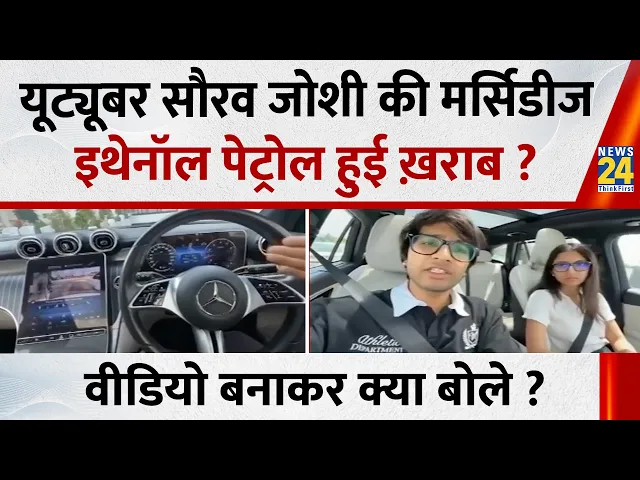
In a recent vlog titled "Race With Brothers. Kon Jeetega ?", Joshi pulled back the curtain on a nightmare scenario for any luxury car owner. Showing live dashboard metrics from his ₹80-lakh-plus Mercedes-Benz GLC 300 4MATIC, he revealed a shocking collapse in fuel efficiency. Over a 48-hour window, his SUV’s average plummeted from a comfortable 17 kmpl down to 9, and finally crashed to a staggering 5 kmpl.
Joshi pointed the finger squarely at one culprit: E20 petrol.
With over 41 million subscribers tuning in, his frustration resonated instantly with millions of vehicle owners across the country. But what exactly is going on beneath the hood? Is ethanol-blended petrol truly destroying premium engines, or is there more to the story?
What Sourav Joshi Claimed: The Viral Breakdown
In the video, a visibly disheartened Joshi shared his live dashboard metrics alongside his wife and fellow creator, Avantika Bhatt.
"I spent so much money on this car and look at the condition, all because of ethanol," Joshi complained, adding that he feels increasingly hesitant at the fuel station. For a creator living in Haldwani, Uttarakhand, the anxiety is compounded by logistics. Mechanical failures in a premium German vehicle often mean flatbedding the car all the way to Delhi for repairs, accumulating exorbitant costs.
Joshi even joked that his only relief from "ethanol worries" was driving his newly acquired electric Mercedes G-Wagon. The clip spread rapidly on X (formerly Twitter) and Instagram, reigniting a fiery public debate over India's aggressive green fuel transition.
Decoding E20 Petrol: Why Is India Blending Ethanol?
To understand the controversy, we first need to look at what E20 actually is. E20 petrol is a blend of 80% conventional fossil petrol and 20% ethanol (an organic alcohol derived primarily from sugarcane, corn, and agricultural waste).
The Government of India has aggressively rolled out the E20 mandate nationwide. The policy is designed to solve three monumental issues:
Reducing Crude Imports: India imports over 80% of its crude oil. Blending domestically produced ethanol saves billions of dollars in foreign exchange.
Lowering Emissions: Ethanol burns cleaner than pure petrol, contributing significantly less carbon monoxide and hydrocarbons into the atmosphere.
Supporting Farmers: Sourcing ethanol from agricultural output provides a massive financial boost to India's rural economy and farming sectors.
While the macroeconomic benefits are undeniable, the microeconomic reality hitting everyday drivers - especially owners of high-performance vehicles - is causing a serious wave of public anxiety.
The Science: Why Does Ethanol Impact Mileage?
Is it scientifically possible for ethanol to cause a drop in mileage? Yes. Can it cause a drop all the way down to 5 kmpl on its own? Unlikely.
To understand why mileage drops, we have to look at energy density. Ethanol contains roughly 33% less energy per unit of volume than pure petrol. When your car burns a blend like E20, the engine has to inject slightly more fuel to achieve the exact same combustion energy.
According to the Ministry of Petroleum and Natural Gas, an E20 blend naturally results in a minor 3% to 5% drop in fuel economy due to this lower calorific value.
A drop from 17 kmpl to 16.2 kmpl is standard science. A drop down to 5 kmpl points to secondary issues.
The Real Culprits Behind the "5 kmpl" Crisis
If standard E20 only accounts for a tiny dip in mileage, what caused the dramatic failure shown on Joshi’s dashboard? Automotive experts highlight three distinct possibilities:
1. The Real-Time vs. Long-Term Display Illusion
Modern luxury cars feature highly sensitive, dynamic trip computers. If you reset your trip meter or look at the "Instantaneous Mileage" while idling in heavy bumper-to-bumper traffic, climbing steep hills in Uttarakhand, or aggressively revving the engine, the dashboard can easily display single-digit numbers like 4 or 5 kmpl. Once the vehicle hits a smooth highway cruise, that number climbs back up to double digits. It remains unclear whether Joshi was viewing a brief, real-time snapshot or a long-term average.
2. Fuel Adulteration Under the Garb of E20
This is where the luxury car market gets highly vulnerable. Santosh Iyer, Managing Director and CEO of Mercedes-Benz India, recently addressed the growing anxiety among luxury car buyers.
While asserting that all Mercedes-Benz models sold in India since 2020 are natively engineered to handle ethanol-blended fuels safely, Iyer highlighted a dark reality: “We have seen increased fuel adulteration happening under the garb of E20.”
Because ethanol readily mixes with water, poorly maintained underground fuel pumps at local petrol stations can accumulate moisture. If water gets into the fuel tank, it triggers a process called phase separation, where the water and ethanol split from the petrol and sink to the bottom. If an engine sucks up this corrupted mixture, mileage plummets, and severe engine damage can occur.
3. Engine Incompatibility and Material Degradation
Ethanol is highly corrosive to certain materials. In older vehicles or engines not explicitly tuned for high blends, ethanol can degrade rubber seals, gaskets, and aluminum fuel lines. It can also loosen up debris in older fuel tanks, clogging fuel injectors and drastically disrupting the air-fuel mixture, forcing the engine into a highly inefficient state.
Government and Automaker Reactions: The Official Stance
In the wake of the viral social media backlash, the government has moved quickly to defend the green fuel rollout.
Union Petroleum and Natural Gas Minister Hardeep Singh Puri dismissed the online concerns as a "misrepresentation". Puri stated that India has been running millions of vehicles successfully on ethanol-blended fuel, noting that roughly 20 crore two-wheelers and 20 lakh four-wheelers utilize the fuel without systemic failures.
"The automobile manufacturers, as well as the people who service these vehicles, all say there is no difficulty. Why this sudden interest?" - Hardeep Singh Puri, Union Minister
Furthermore, Union Road Transport and Highways Minister Nitin Gadkari challenged critics to bring forward concrete, scientific proof linking engine damage directly to standard E20 fuel, reiterating that the blend has undergone years of rigorous validation.
The Policy Dilemma: What Needs to Change?
Sourav Joshi's viral vlog has highlighted a critical flaw in how India is managing its green transition: a lack of consumer choice at the pump.
As fuel stations rapidly convert their infrastructure entirely to E20, owners of vintage cars, older commuter vehicles, and ultra-high-performance sports cars are left with very few alternatives. Industry leaders, including Mercedes-Benz India, have urged policymakers to offer multiple grades of fuel at the pump during this massive transitional period. Giving drivers the freedom to pay a premium for unblended, pure petrol would protect older or highly specialized machinery while allowing the mainstream fleet to adopt E20 cleanly.
Checklist: How to Protect Your Vehicle in the E20 Era
If you are a car or motorcycle owner in India navigating the E20 fuel transition, you do not need to panic, but you should take proactive precautions:
1.Verify Vehicle Compatibility: Check Manual.
Look up your vehicle's manufacturing year and user manual. Most cars built in India after 2020 - and explicitly after April 2023 - are built with material components fully compliant with E20 fuel.
2.Stick to Reputed, High-Volume Fuel Stations: Avoid Adulteration.
Fuel adulteration and water contamination are the real dangers. Avoid low-tier or remote filling stations where underground storage tanks might gather moisture. Use high-volume, company-owned petrol pumps.
3.Avoid Leaving Fuel Sitting Idle: Prevent Phase Separation.
Ethanol absorbs moisture from the air over time. If you leave a car sitting unused for months with a half-empty tank of E20, the fuel can undergo phase separation. If storing a vehicle, keep the tank full to minimize air space, or consider using a fuel stabilizer.
4.Regular Fuel Filter Inspections: Routine Service.
Because ethanol acts as a solvent, it cleans out gunk from fuel lines and deposits it directly into your fuel filter. Ensure your mechanic checks and replaces the fuel filter at regular recommended intervals to maintain smooth fuel delivery.
Conclusion: A Symptom of Transition Anxiety
Sourav Joshi’s Mercedes controversy isn't just about a drop in a YouTuber's dashboard average; it is a textbook symptom of public anxiety during an unprecedented national structural shift.
While the macro benefits of ethanol - slashing national pollution and reducing dependency on foreign oil - are critical to India’s future, the execution requires absolute transparency. Strict quality checks at local fuel pumps are required to stop adulteration, and auto manufacturers must do a clearer job of educating consumers.
Until consumer trust is firmly established at the fuel station, a single single-digit dashboard reading from a top influencer will continue to turn into a national headline.